
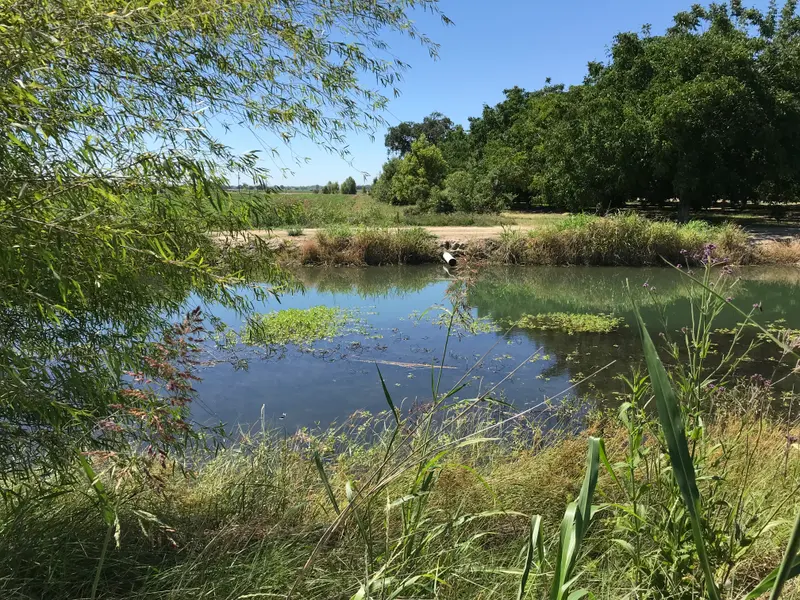
The wildlife value of a rice property is not contained neatly inside a single field. Waterways, banks, nearby wetlands, and neighboring farms can all influence how animals use the landscape. The giant garter snake is a particularly clear example of why those connections matter.
This California native is federally listed as threatened. It uses aquatic habitat for feeding and nearby uplands for functions such as shelter and overwintering. Rice fields and associated irrigation waterways have become part of the habitat available to the species within its remaining range. U.S. Fish and Wildlife Service species profile (opens in a new tab).
For landowners, the useful starting point is therefore a landscape map, rather than a view of cropped acreage alone.
The canal and the field work together
A canal can provide water and cover, but its ecological role also depends on the surrounding setting. Research reported by the U.S. Geological Survey in 2019 found that tracked snakes frequently used canals and that the amount of rice nearby was associated with survival. The finding points to a relationship between the waterway and the broader agricultural landscape. USGS on giant garter snakes and rice agriculture (opens in a new tab).
More recent USGS work examined rice idling, occupancy, and survival using data from 2016 through 2024. The 2026 report associated more surrounding rice with better outcomes for several measures of snake populations and persistence. It also examined uncertainty about the processes behind those relationships. These are findings about observed landscape patterns, not a guarantee that an individual field practice will produce a specified conservation result. USGS report on rice idling and giant garter snakes (opens in a new tab).
The practical implication is to consider what a proposed change means beyond the area being changed. A field left dry, a maintained waterway, and a neighboring wetland may affect different parts of the same habitat network.
Research on a working ranch
Davis Ranches describes USGS giant garter snake research on the property beginning in 2011, including work to understand occupancy and movement. That local history provides an example of a farm contributing to the information needed for better habitat management. Davis Ranches conservation program (opens in a new tab).
The value of this kind of partnership lies partly in continuity. A working operation can help researchers understand when and why field conditions change. Researchers can help the operation understand what wildlife observations do, and do not, reveal about the landscape.
Planning with the whole property in view
For a property review, it is useful to identify waterways, connected wet areas, vegetated banks, and adjacent uplands before focusing on a specific improvement or management change. Assemble any existing habitat assessments, recorded agreements, and operating restrictions alongside the farm's water and maintenance records.
Then define the proposed action precisely. Routine inspection, changes to a bank, altered water timing, and a larger land-use change are different activities. Their implications depend on the site and the governing requirements. Early coordination with qualified biological and permitting professionals can make a proposed project more concrete and easier to evaluate.
The broader conservation aim is not satisfied by treating every rice acre as interchangeable with a natural wetland. The federal recovery plan emphasizes sustaining and restoring the habitat systems the species needs. Agricultural habitat has a role within that larger effort. Giant garter snake recovery plan (opens in a new tab).
For owners and buyers, the giant garter snake offers a useful reminder: land function extends across property lines and through the seasons. Understanding those connections is part of understanding both the responsibilities and the possibilities of a rice property.
Read more about land stewardship and conservation land.